




_huge.JPG)


Historical Dobby and Drawlooms
Historical Handloom Technology (2016–2022)
Research into historical handloom technology formed the first stage of my broader investigation into the technological history of Estonian textiles. Conducted between 2016 and 2022, this study focused on the development of upgraded handlooms in Estonia and resulted in the master's thesis "The Introduction of Dobby Looms and Draw Looms in Estonia at the End of the 19th Century and Beginning of the 20th Century" (University of Tartu Viljandi Culture Academy, 2022).
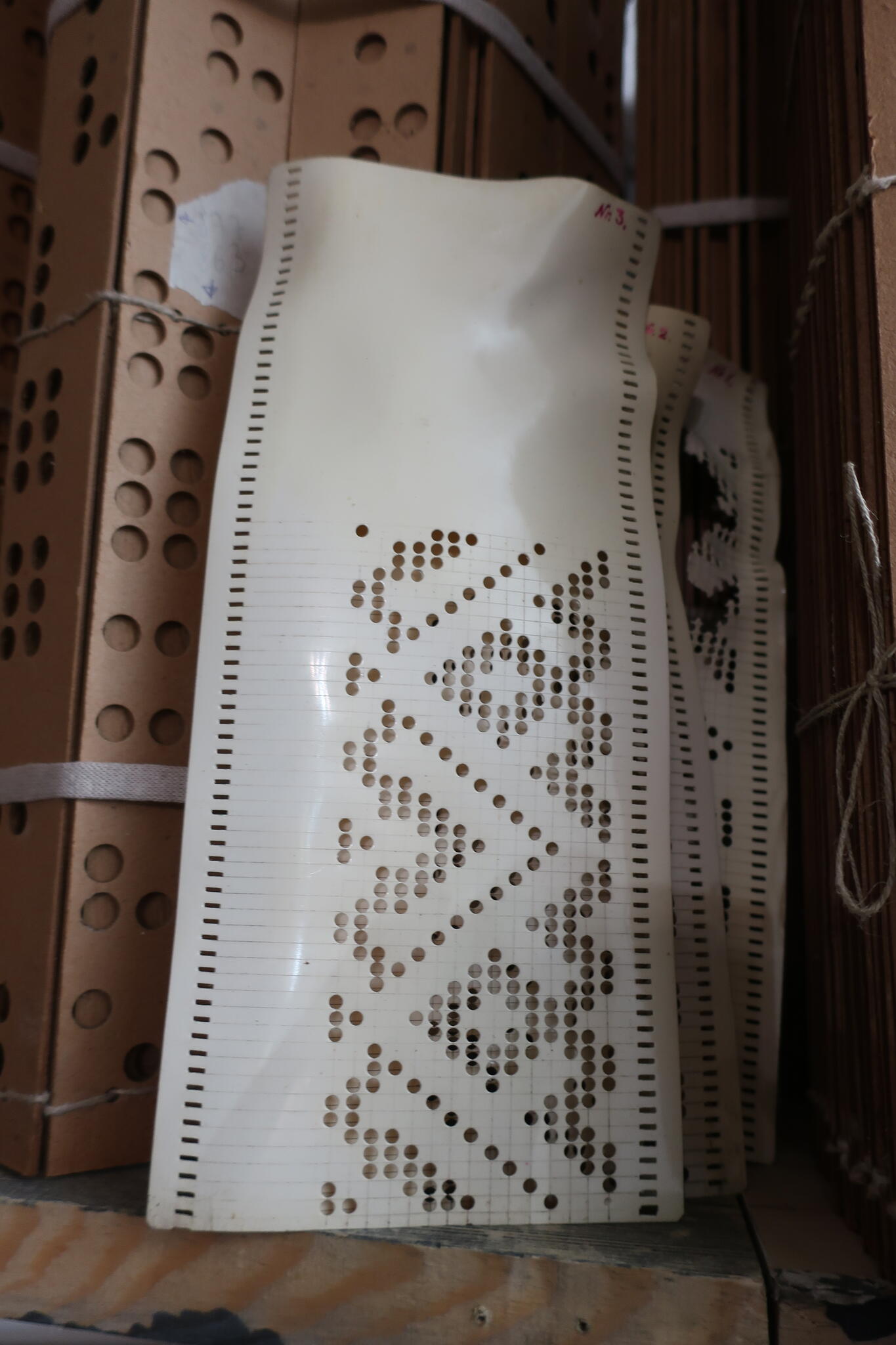
The research documented how dobby looms and drawlooms reached Estonia, how they spread through weaving schools and professional training, and how these technologies influenced the development of Estonian handweaving during the late nineteenth and early twentieth centuries. Ten historical handlooms preserved in the IIDA Weaving Museum were examined together with archival sources, historical newspapers, weaving manuals, handwritten pattern books and field research carried out in Estonia, Finland, Sweden, Germany, Austria and Latvia.
A significant part of the research involved analysing the technological construction of historical handlooms, their pattern-selection mechanisms and their weaving capabilities. The study also documented weaving knowledge that had largely disappeared during the twentieth century and reconstructed the technological principles behind several historical loom systems.
Although this research did not focus on Estonian folk costume fabrics, it established a comprehensive understanding of the technological development of handweaving in Estonia. It also laid the methodological foundation for my later research into the technological reconstruction of historical linen and woollen textiles, where the emphasis shifted from weaving equipment to the technological properties of the fabrics themselves.
Historic Loom Collection
This catalogue documents the historic handlooms that have formed part of my research collection since 2016. The collection was assembled to support the study of historical weaving technology and includes examples of dobby looms, drawlooms, jacquard looms and other historically significant weaving equipment.
Today, a significant part of the collection is housed at the Olustvere School of Service and Rural Economics, where the looms are used for teaching and research. The remaining looms are preserved in the IIDA Studio collection for ongoing research, documentation and conservation.
The collection serves both as a historical archive and as a practical research resource, providing opportunities to study original weaving mechanisms, reconstruct historical weaving technologies and preserve knowledge of traditional handloom engineering for future generations.
Historical Dobby-Woven Museum Textiles (Ongoing Research)
Building upon my previous research into the history of dobby looms in Estonia, this ongoing project investigates a collection of historical Estonian museum textiles that are believed to have been woven on dobby handlooms. While the technological development of these looms has already been documented, many surviving museum textiles have never been systematically identified or analysed from the perspective of the weaving technology used to produce them.
The research combines the technological analysis of museum textiles with the study of historical weaving drafts, loom mechanisms and original dobby handlooms. Particular attention is given to weave structures, pattern systems and the technological characteristics that distinguish dobby-woven fabrics from textiles woven on ordinary handlooms. Original museum textiles are continuously compared with the technical capabilities of historical looms in order to determine how they were woven and how they can be accurately reconstructed.
The long-term objective is to identify, document and reconstruct this little-studied group of Estonian textiles while expanding our understanding of historical dobby weaving technology. Current case studies include ERM A 611:40 and ERM A 228:28, together with comparative research on related historical weaving traditions in neighbouring countries.